Where it comes from
Madhubani painting, also called Mithila painting, comes from the Mithila region, which spans northern Bihar and the neighbouring Terai of Nepal. It takes its popular name from Madhubani district, where villages such as Jitwarpur, Ranti and Rasidpur became its best-known centres.
For generations, women painted the walls and floors of their homes for rituals, festivals and above all weddings. The most important of these was the kohbar, painted in the kohbar ghar, the chamber where a newly married couple spent their first nights, and filled with symbols of fertility and union: the lotus, bamboo, fish, turtles and parrots.
Colours came from what was at hand: lampblack for black, rice paste for white, turmeric for yellow, indigo for blue, palash flowers for orange and vermilion for red, bound with gum or goat's milk. Painters used fingers, twigs, brushes, nib pens and matchsticks.
How the world found it
In 1934 a major earthquake struck Bihar. William G. Archer, the British subdivisional officer at Madhubani, went to inspect the damage and found, on the broken inner walls of houses, paintings that outsiders had rarely seen. He photographed them, and in 1949 published "Maithil Painting" in the art journal Marg, the first serious writing on the tradition.
The real turning point came with the severe drought of 1966–68. To create a source of income and head off famine, Pupul Jayakar, then head of the All India Handicrafts Board, sent the Bombay artist Bhaskar Kulkarni to Madhubani to encourage women to paint on paper for sale. When the first paintings on paper were exhibited in Delhi in 1967, they caused a sensation. A ritual wall art had become something that could travel.
Five styles, many communities
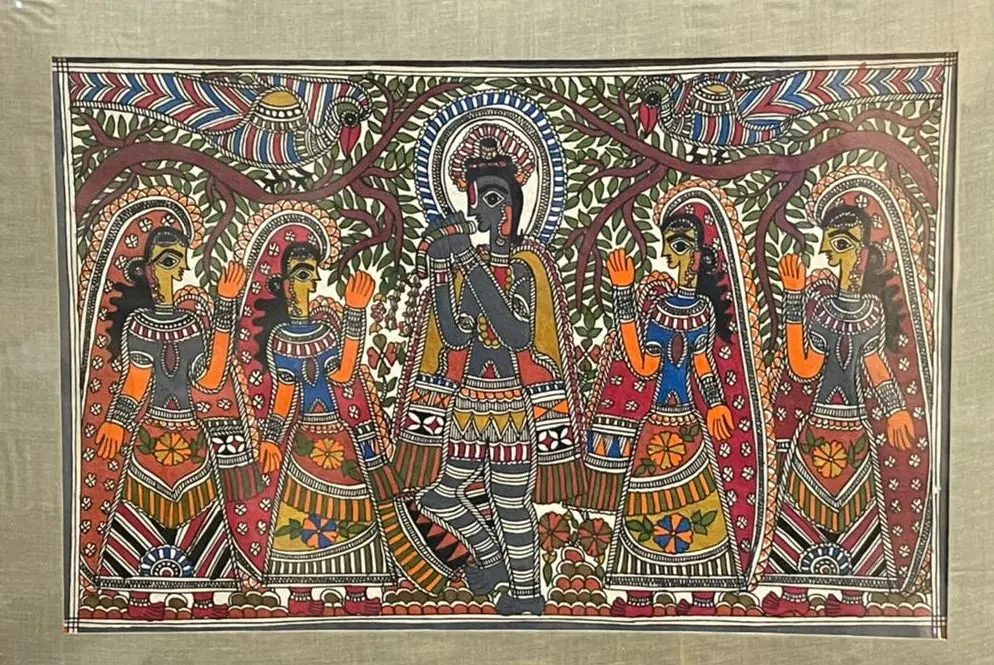
Madhubani is usually described through five styles: Bharni (filled with bright colour), Kachni (fine line work, often in one or two colours), Tantrik (deities and religious diagrams), Godna (drawn from tattoo patterns) and Kohbar (the wedding-chamber imagery). The first painters on paper were mostly Brahmin and Kayastha women, and Bharni and Kachni are the styles most associated with them. The painting at the top of this page, from the Krishnayan collection, is a Bharni-style work: Krishna playing the flute among the gopis, every figure filled with colour and edged in fine double lines.
Dalit women began painting on paper in the late 1960s and early 1970s, among them Jamuna Devi, from the Chamar community, and Shanti Devi, from the Dusadh community. Dusadh painters in Jitwarpur developed the Godna style from the tattoo designs worn by women of their community. Chano Devi is remembered as one of its early leading painters. Dusadh artists also paint the epic of Raja Salhesh, their own cultural hero, offering a history of their community alongside the Ramayana scenes favoured by upper-caste painters.
The artists
Madhubani is unusual among Indian folk traditions in how many of its painters have been nationally honoured, nearly all of them women. Among those awarded the Padma Shri:
- Jagdamba Devi (1975), the first Madhubani painter to receive it.
- Sita Devi (1981), of Jitwarpur, whose Bharni paintings helped define the style for collectors in India and abroad.
- Ganga Devi (1984), known for her Kachni line work.
- Mahasundari Devi (2011), of Ranti, who also worked to organise and teach other women painters.
- Baua Devi (2017), of Jitwarpur, famous for her nag kanya (snake-maiden) paintings. Her award gave Jitwarpur its third Padma Shri.
- Dulari Devi (2021), from the Mallah (fishing) community, who began as a domestic worker in the household of Mahasundari Devi and Karpoori Devi, and learned to paint from Karpoori Devi.
Dulari Devi's story shows how far the art has travelled: from the walls of a few communities to a means of livelihood and recognition for women who were once kept out of it.
What the art is losing
Madhubani is not dying in the way Saura painting is. More people paint it than ever. But what is being lost is harder to see.
- The mass market. Madhubani motifs now appear on sarees, tiles, mugs, diaries, laptop sleeves and home decor, and these products often earn more than original paintings. When the same fish and peacocks are printed by the thousand, hand-painted work has to compete on price.
- Middlemen. Many painters, especially women who cannot easily travel, depend on agents for orders and sell at low prices while their work is resold at much higher ones. Artists also describe a loss of the exhibitions and fairs that once let them sell directly.
- A GI tag that covers few. Madhubani painting received a Geographical Indication tag in 2007, but by late 2025 only 51 authorised users were listed in the GI registry, while hundreds of households in Jitwarpur alone practise the art.
- Shortcuts. Natural colours take time and labour, and many newer painters use cheaper synthetic paints and non-traditional colour schemes, painting faster for volume.
- Meaning thinning out. As the motifs become decoration, the ritual knowledge behind them, of what a kohbar is for, or why a fish or a bamboo grove appears, is held by fewer people.
How to tell, and how to help
A hand-painted Madhubani piece shows small irregularities in line and colour, a slightly raised surface where pigment sits on paper or cloth, and usually a painter's name. Printed copies are perfectly even and flat. Buying from painters directly, or from sellers who can name the artist and village, keeps more of the price with the women who make the work, and keeps the tradition in their hands.
How Krishnayan works with Madhubani painters
Krishnayan works directly with the artists, with no middlemen between us. Every design starts as an original painting by an artist we know by name, and we carry that same artwork into things people wear, live with and use every day:
- Apparel: scarves, stoles and sarees.
- Home: bed linen, cushion covers and table runners.
- Mugs: the painting applied by digital transfer.
- Kitchen: trays and coasters.
That is the difference from the mass market described above. A motif copied by the thousand earns its painter nothing. A stole or a tray made from a painter's own work, with the painter, carries her art into more homes and keeps her at the centre of it.
Sources
- David L. Szanton, "The Politics of Mithila Painting," Ethnic Arts Foundation / UC Berkeley ORIAS (2017).
- W. G. Archer, "Maithil Painting," Marg, vol. 3, no. 3 (1949), pp. 24–33.
- "Authenticity in question: Why Madhubani art deserves better protection," Down To Earth, 27 November 2025.
- Government of India Padma award lists, 1975–2021.
- "An art form of Bihar's Dalit women asserts its unique identity," BehanBox, 25 May 2023.
