Who the Saura are
The Saura (also written Sora or Savara) are one of the oldest tribal communities of eastern India. The painting tradition belongs above all to the Lanjia Saura, the hill Saura, who are recognised as a Particularly Vulnerable Tribal Group. Their villages lie mainly in Rayagada, Gajapati and Koraput districts of southern Odisha, with communities in neighbouring Ganjam as well.
A house for the gods
The paintings are called idital (also ittal or ikon), after Idital, a principal deity of the Saura. The anthropologist Verrier Elwin, who lived among the Saura and wrote about their religion, described an ittal as a kind of house for the gods, spirits and ancestors of the Saura world. A painting was made because something needed to be said to them: at a birth, a harvest, a marriage, or when a new house was built. A new home was expected to have one, usually painted in a dark inner corner and dedicated with prayers and offerings.
Traditionally the work was guided by the kudan, the community's priest and shaman. The kudan learned what a spirit wanted and either painted the image or directed it, and then explained what each figure meant. Once its purpose had been served, the painting was left on the wall to fade with time and weather.
How a Saura painting is made
The wall is first coated with red or yellow ochre earth. On that warm ground the figures are drawn in white, from rice paste or ground white stone, using brushes cut from tender bamboo shoots. Other natural colours, such as vermilion and extracts of tamarind seed, flowers and leaves, are used sparingly.
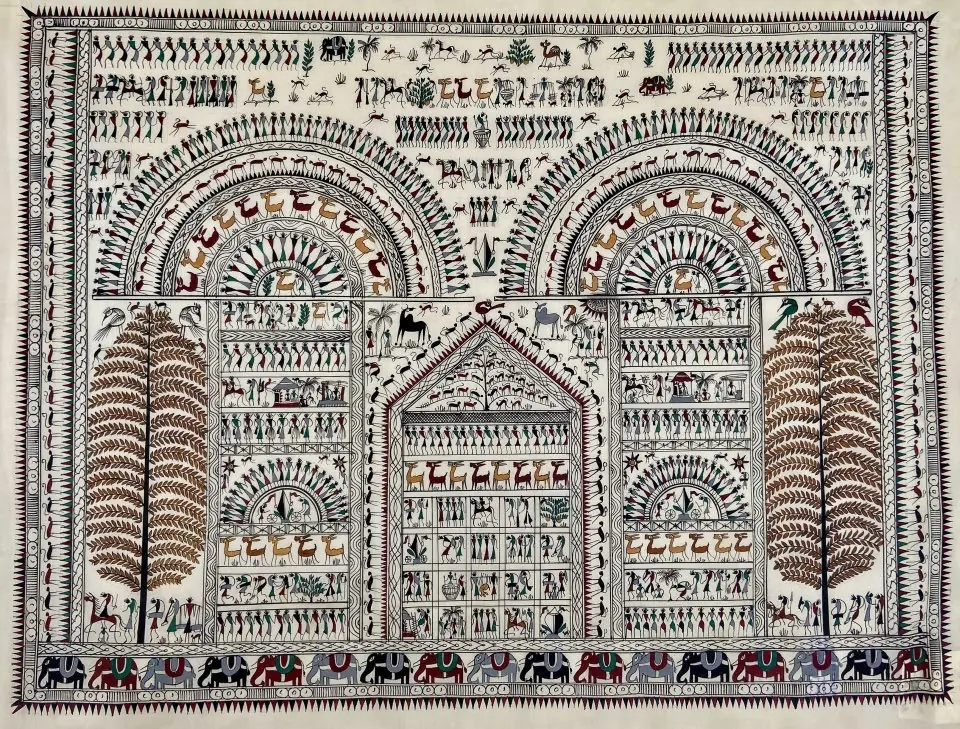
The visual language is instantly recognisable: people, horses, elephants, monkeys, the sun and moon and the tree of life, all built from simple lines and triangles and packed inside a frame. Painters traditionally work from the border inwards, filling the space in what has been called a "fish-net" approach. Saura work is often confused with Warli painting from Maharashtra, but the two differ. Warli figures are made from two joined triangles and clearly show men and women apart, while Saura figures are looser and are not usually marked by gender.
The painters
For most of its history this was not an art of signed works or famous names. The painter was a ritual specialist or a member of the household, and the painting belonged to the occasion, not to the artist. As Saura painting has moved onto paper, canvas and cloth over the last few decades, a new generation of Saura painters has begun selling work under their own names, supported in part by Odisha government training programmes and exhibitions. The painting at the top of this page, from the Krishnayan collection, is one such work: painted on cloth rather than a wall, with added colour, but keeping the tradition's crowded rows of people and animals, its trees of life and its framed, border-inward composition.
In January 2024 the "Painting of Lanjia Saura (Idital)" received a Geographical Indication (GI) tag. The application was filed by the Idai Idital Association together with Odisha's Scheduled Castes and Scheduled Tribes Research and Training Institute. The tag ties the name to the community, so that work sold as Lanjia Saura painting should come from Lanjia Saura painters.
Why the tradition is fading
Saura painting is in a strange position: more Saura-style images are sold today than ever before, while the tradition that gave them meaning is weakening.
- The ritual world is shrinking. Changes in Saura religious life, including conversion to Christianity (Baptist missions have worked in the Paralakhemundi area of Gajapati since the early twentieth century), mean fewer households call on a kudan. Without the ceremonies, there is little reason to paint a wall, and old paintings are left to fade.
- Fewer ritual painters. The specialists who knew what each spirit required, and what each figure meant, are steadily declining in number.
- Displacement. Development and infrastructure projects in the region have moved communities away from the villages and homes where the paintings lived.
- Meaning lost in the market. Paintings made for sale often keep the look but drop the purpose, turning a message to the gods into a pattern. Writers on the tradition note that few Saura themselves have benefited much from the commercial boom.
- A slow craft in a fast economy. For young people, traditional methods can seem slow and poorly paid compared with other work.
How to support it
The surest support is to buy from Saura painters, or from sellers who can tell you who made a piece and where. Work on natural ochre grounds, with the dense, border-inward composition of the wall paintings, is closer to the tradition than a generic stick-figure motif copied onto merchandise. And it is worth knowing the story: every crowded little world on a Saura wall began as a conversation with someone the family had lost, or a god they needed.
How Krishnayan works with Saura painters
Krishnayan works directly with the artists, with no middlemen between us. Every design starts as an original painting by an artist we know by name, and we carry that same artwork into things people wear, live with and use every day:
- Apparel: scarves, stoles and sarees.
- Home: bed linen, cushion covers and table runners.
- Mugs: the painting applied by digital transfer.
- Kitchen: trays and coasters.
Writers on the tradition note how little the commercial boom has reached the Saura themselves. Working with the painters, rather than borrowing their style, is how we try to change that: the artwork on a cushion or a coaster is theirs, and it comes from them.
Sources
- C. B. Patel, "The Sauras and Their Panoramic Paintings," Orissa Review, January 2005.
- Verrier Elwin, The Religion of an Indian Tribe (1955).
- Government of Odisha GI announcement, reported by PTI, 4 January 2024; GI Registry application no. 871.
- MAP Academy, "Saora Painting."
- "Saura invocations," The Hindu, 19 June 2011.
